Reading Food Product Labels
- Wong Song
- Aug 9, 2021
- 7 min read
Updated: Feb 14, 2022
How to Read Food Labels Part 1: Product Descriptions

Welcome to the 21st century. We are constantly inundated by information on a daily basis that makes us scream for sensory relief. Why not cram your head with MORE FACTS and join me on a special multi-part series on how to read and understand food descriptions on labels, ingredients lists and nutritional tables? I'll try to make it fun, I promise!
Reading ingredients lists and labels shouldn't be seen with aversion. The benefits of knowing what goes into that no-need-to-refrigerate pack of guacamole are manifold. Today's post will be about how to more critically read and understand food descriptions on labels so that you may become a more savvy consumer, for the following reasons:
Firstly, knowing how to read food labels helps you understand whether it is healthy and good for you (as guacamole often is seen as).
Secondly, it aids in giving precise information on whether you are truly getting what you paid for (or what you think you paid for), and in the right amount.
Lastly, you can flex on your friends that you know your shit.
I won't be covering topics such as detailed nutritional information and calorie counting in this post, as that would be too much effort (kidding). It would just be too long and defeat the point that I am trying to make with today's post: You should be able to tell at a glance, in perhaps 20 seconds or less, what is worth your $$$$, and your calories.
Don't get me wrong, it isn't my place to (nor should I) judge what you like to eat. I'm simply advocating for greater emphasis on reading labels and awareness about what you are enjoying. I feel that too many people simply chow down and have nary the slightest clue of what they are eating.
A Tale of Two Guacs
Water, Tomato Puree, Vegetable Oil, Modified Food Starch, Maltodextrin, Contains less than 2% of the following: Dehydrated Onion, Salt, Whey Powder Concentrate, Sugar, Natural & Artificial Flavours, Lemon Juice Concentrate, Avocado Powder.....
Enter Exhibit A: An ingredients list for a widely available snack dip in Singapore supermarkets. Can you tell what this dip is? Read through the list and make a guess.
Hmmm... Tomato puree... Is it a salsa? Could be, it has onion in it... Wait a minute... Whey Powder! Gym junkies' eyes would light up upon seeing that. Is this some tomato-flavoured Franken-Protein shake? Lemon juice! Yikes! Avocado powder?!?!?! Could this be the result of a drinking game gone wrong? What have tortilla chips done to deserve this fate?
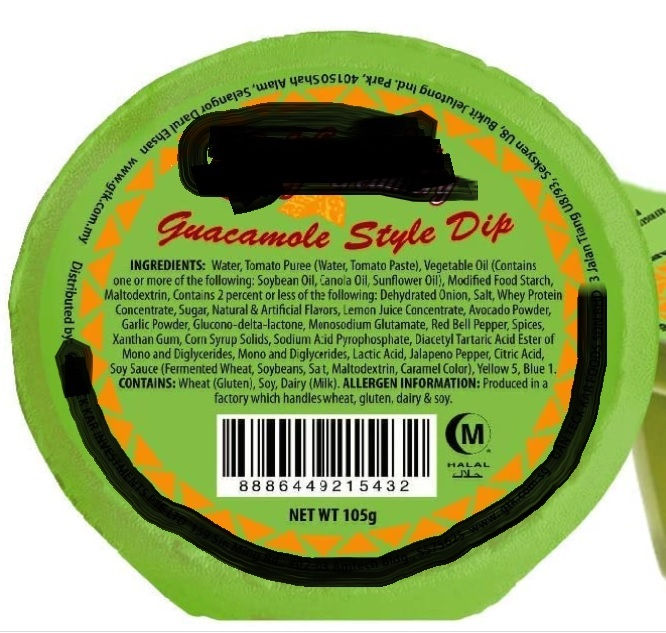
Exhibit B: Definitely NOT a protein shake.
Surprised? Shocked? I hope you were! The word guacamole is quite apparent. This is the millennial's toast topping of choice, the bane of personal finance gurus worldwide.
Well, not exactly. Avocado aficionados and epicureans alike might soak their hankies with tears upon tasting this common supermarket staple (I've blurred out the brand so as not to be sued, so if you know the brand, you know). Upon closer inspection, the discerning reader would notice that this is a guacamole-style dip. Not a guacamole, but a guacamole-style dip.
The Devil is in the Details
Now we come to the first point of this post: Product descriptions. What is the difference between a guacamole and a guacamole-style dip?
Put yourself in the shoes of a food manufacturer; you want to profit and retire by the ripe old age of 40 having Sex on the Beaches (the cocktails, you filthy lot!!!) You do everything in your power to sell your product at as high a price as you can, and as low a cost as you can squeeze out of your input.
You grab a can of tomatoes, pour some oil in it, add a pinch of avocado powder and call it guacamole. You then sell it as Honest Joe's Guac and charge S$11 per 200g tub at the supermarket, the same price as Really Really Honest Sam's Guac, which contains the more expensive real avocado. Poor customer Karen buys your $11 phoney guac and wonder why guac tastes terrible, and relegates all things guacamole forever to the back of their minds. It's a nightmare scenario for legitimate and honest food manufacturers.
That's why governments around the world have enacted laws that mandate precision in food labelling. I won't be diving into the specifics, but if and when you would like to have a read for yourself, you can find the edifying details in the Singapore Food Association website (click the link).
That is why reading labels is important; you want to know what you are buying exactly, and what goes into it.
Now compare this ingredients list with the one above and see if you can spot the difference:
Ingredients:
Avocado, tomatoes, sour cream, lemon juice, white onions, coriander, salt, jalapenos, diced red chilli, garlic puree, black pepper, green colouring, preservative.
It doesn't take an eagle-eyed guac lover to discover that avocado tops the list of ingredients in this list. This means that avocado is the most plentiful ingredient by weight in the guacamole. (Remember this fact, I'll test you again in the next article).
There is also no sign of the aforementioned whey protein powder. Care to take a guess how this particular manufacturer labels its product? Again, I've taken the liberty of removing the brand name, but rest assured this isn't a stock image or something I made up (I can't design to save my life).

Exhibit B: Chonky Guacamole
As we can plainly see, the product above is described as simply "guacamole", without the sneaky addition of the word "style" to ruin the party. It is often true that on food labels, as well as ingredients lists, simpler is better. "Guacamole" is a lot more straightforward a product label than "Guacamole-style dip", which sounds to me that the manufacturer has some tricks up their sleeves (Disclaimer: I'm not implying in any way that the manufacturers are shady or are lying!)
But Why, Oh Why do I Need to Know This?
It's simple. I want you, dear reader, to know what goes into your guac. Similarly, to know what goes out of your wallet for that guac, and whether it's worth the moolah. After all, if we millenials are squandering away our futures into avocado toast, it better be at least half-decent, right?
The economics majors here might think that by comparing the two ingredients lists presented above, you'd conclude that the guacamole-style dip would be loads cheaper than its decidedly more wholesome counterpart.
But is itttt?????? I think I'm making it a bit too obvious. Here I present the two links for the two featured guacs in this article: Exhibit A and Exhibit B (Please sponsor me, Shopee). These are two fairly accessible brands of guac for Singapore residents, and, with some simple quick math, we can arrive at a head-to-head comparison of their cost/gram:
Guac Value Contender | Price and Weight (In grams) | Price (Per gram) |
Exhibit A (Guacamole-style dip) | $5.27 (after 4% Shoppee Dicsount), 105g | $0.0501/g |
Exhibit B (Chonky Guacamole) | $7.50, 150g | $0.05/g |
At first glance, the real Guac McCoy seems to be retailing at a steep premium as compared to the Guac-style dip. How fitting, you might think, the wholesome guac manufacturer is squandering his retirement on avocado. They must be millenials. I arrived at the following scandalous conclusion after doing my quick math: B IS EVER SO SLIGHTLY CHEAPER THAN A!
Imagine my slack-jawed amazement at the fact that the stars have aligned in my favour to help me illustrate this example (I swear it wasn't intentional).
How could it be that Exhibit A, that contains much less avocado than B, be priced even at the same level? Is there some way to tell what is more worth my moolah?
I can picture some of you scratching your heads, heaving a sigh of collective resignation. Now that you have encountered this positively life-changing piece of information, you feel you will have to spend the rest of your lives crawling the aisles of your local supermarket/online shopping platform, reading labels and cursing me for making your shopping trips that much more complicated.
Fret not. As mentioned earlier, the purpose of this article here is to help you glance in seconds how to figure out this conundrum. The guacamole vs guacamole-style dip example can be extended to many food products outside the avocado realm as well:
Chocolate milk vs chocolate-flavoured milk
Bacon bits vs Bacon-flavoured bits
Full cream milk vs Filled milk beverage
Apple juice vs Apple-flavoured juice beverage
Cheddar cheese vs Pasteurised processed cheese product (ewwwww)
Look out for these subtle, yet important differences in labelling to tell if you would potentially enjoy the product more/get more bang for your buck. Remember that in general, you want your food label to be simple. It should be straight to the point and tell you immediately what you are paying for. If it is guacamole, it should simply just be called that.
Concluding Thoughts
Hopefully this article has served to help you understand a bit better how to decipher food descriptions. The topics that I have covered here are non-exhaustive, as the wide-range of food labelling practices is beyond the limited scope of this article. The concept of how to read food labels and is, however, quite generalisable and applicable to a wide spectrum of food and drink products.
Yes, you could say that you perhaps love that particular brand of guac-style dip for the nostalgia factor of it reminding you of your chips-for-lunch days. I also understand that you could perhaps buy the guac-style dip for cheaper elsewhere. The point I would like to make is, YOU DO YOU. You are the dipper of your guac. I would be remiss as a fellow food lover to deny others their pleasures, just as I would be remiss as a food writer to not educate the general public. It is only my simple and humble aim to equip you with the right knowledge to make informed and educated purchases.
I am quite content now to stop here, and leave you to practice your newfound skills.
Stay tuned for the next instalment of this series, where I will tackle how to dissect and analyse ingredients lists!
For now, then, bye!
Calvin
10/11/2021
Watch out for more food related content here on Calvin's Chronicles! Articles will be uploaded every once in a while (or twice in a while if I don't procrastinate).
Comments